[ MODULE :: TELECOM_FOUNDATIONS ]
Understanding the core pillars of mobile networks: **Voice**, **Data**, and **Signaling**. Mastering these fundamentals is essential for deep-dive signaling security research.
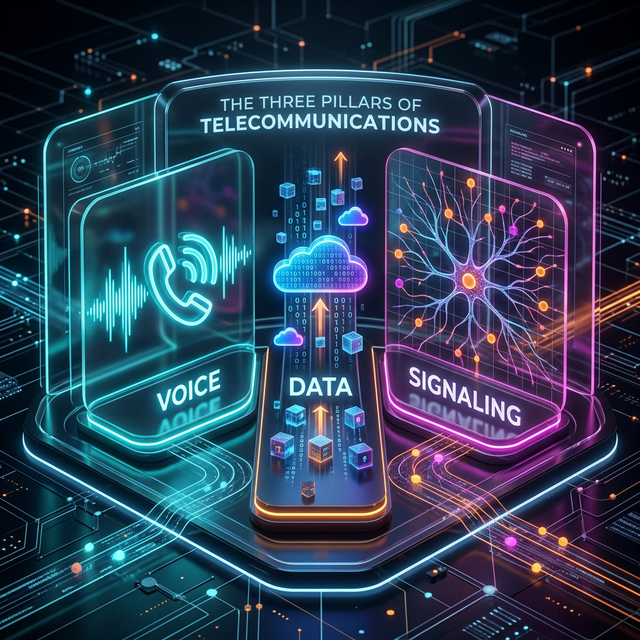
Legacy voice calls utilize Circuit Switching (CS). In modern 4G/5G networks, voice is treated as data over the IP Multimedia Subsystem (IMS). This transition from dedicated circuits to VoLTE/VoNR is a major security shift.
All IP traffic is Packet Switched (PS). In 5G, this is further evolved via Network Slicing, allowing virtualized independent networks with specific QoS (Quality of Service) parameters on the same physical hardware.
Signaling is the control-plane that manages everything. It has evolved from SS7 (2G/3G) to Diameter (4G) and now RESTful HTTP/2 (5G). Each generation brings new protocol-specific attack surfaces.
The two primary consumer models in telecommunications:
• Pre-paid: Users pay in advance for a specific amount of credit or service. Real-time signaling (via CAMEL/IN or Diameter Gy/Ro) is critical to monitor and cut off sessions once credit is exhausted.
• Post-paid: Users are billed at the end of a cycle based on usage. Charging data records (CDRs) are generated and processed offline.
- 2G/3G (SS7)
MAP, CAP, ISUP. Trust-based, legacy routing.
- 4G (Diameter)
S6a, S13, Gx. Complex AVP-based routing.
- 5G (SBA)
JSON/HTTP2. Cloud-native, OAuth-ready.
- IMS
SIP/SDP. The backbone of modern voice/multimedia.